
My solarpunk starter pack

In April 2025, I set out to write a solarpunk romance novel. That’s when I created my Instagram account, @raveenaromance.
Within a few months, people were reaching out to tell me that my rants and raves very intelligent thoughts about solarpunk were resonating with them.
Most people don’t know the word even exists, but many of us are searching for an alternative to dystopia, or to describe the cozy feeling that the Monk and Robot books give us.
My proudest accomplishment, other than writing my book, has been the conversations that people have reported back to me on—chats with neighbors about better stories, discussions with critique partners on how to remove car violence and replace it with some other tragedy lol, picture book authors realizing their books are solarpunk, and more.
Once you’re in the online solarpunk community, you’ll see it’s special and friendly and kinda how Twitter used to be when it existed, but before that, it can be hard to get started.
So here’s my personal starter pack!
I’ll try to update this on a quarterly basis.
Last update: December 2025
Start here
I will listen to anything this man says. I support him on Patreon and wish I had more money so I could give it to him.
Watch the video.
Binge the channel.
Support the Patreon.
Solarpunk is a shining vision of a positive future, a literary and visual genre, and real movement for change, influenced by a diversity of aesthetics and grounded in our existing world, that emphasises the need for environmental sustainability, autonomy, and social justice. Solarpunk is everything from a positive imagining of our collective futures to actually creating it. It derives its name from the cyberpunk genre, but it aims to go beyond what is to what if. Solarpunk looks beyond the limitations of capitalism and beyond the current rift between humanity and nature, focusing on what we should hope for, rather than on just what to avoid. And most importantly, solarpunk motivates action to build the future, today.
Links and all non-book things
Optional history lesson: Republic of the bees: From Steampunk to Solarpunk. This article coined the term in 2008.
A comprehensive reference guide on all things solarpunk, in chronological order: solarpunks.net/Ref
Where to engage: R/solarpunk. Duh. This is a really cool subreddit because people share pictures and current examples from their life on what is part of a solarpunk future. There are also a bunch of creators hanging out in there, and it’s awesome. There’s also a whole separate forum called SLRPNK.net.
A solarpunk writing repository: Jacob Coffin (below) has been organizing this: https://wiki.slrpnk.net/writing:start
Visuals to feed your imagination: Jacob Coffin’s website. I have become Jacob’s solarpunk apprentice (no, he didn’t ask for this) after pestering him via email and then via Discord. He kindly read a draft of BRIGHTER THAN THE SUN and pointed out that you probably shouldn’t have an anaerobic biodigester on the roof of an apartment building because it would maybe leak toxic waste?! Oops. Anyway, he has some fantastic postcards from a solarpunk future, and it’s been a huge inspiration for my novels.
A bite-sized climate action newsletter: Changeletter from Soapbox Project. I write it!
A solarpunk Instagram account: @joan_de_art has amazing graphics and comics that help us reimagine the future.
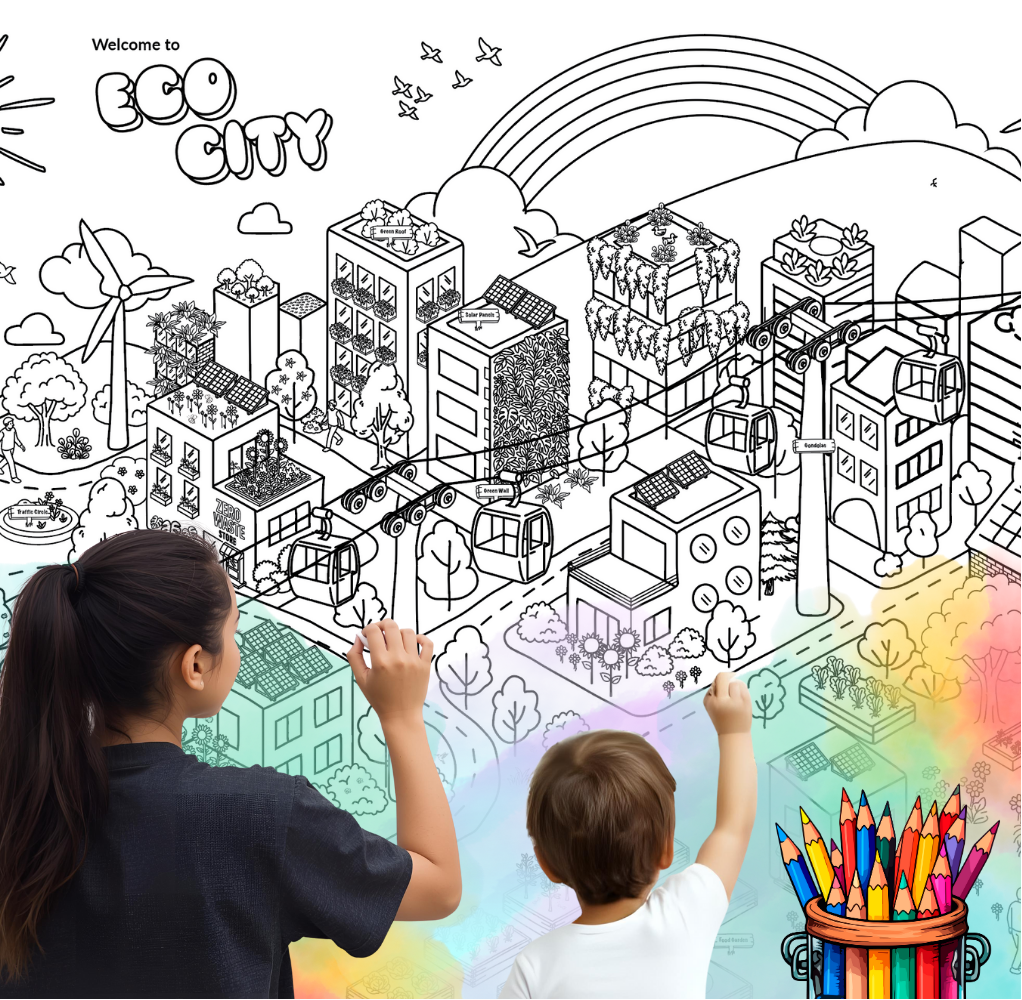
Behavioral design for the future: Katie Patrick doesn’t refer to herself as a solarpunk, but she, with all due respect, totally is. She also has a bunch of hopeful activities you can do with young people in your life, like getting this epic eco city wall mural and coloring it in.
A physical newspaper for good news. You can read online too, but I get the Good Newspaper from Good Good Good in my mailbox every month. If you feel overwhelmed by, um, everything, check it out. The stories are from all around the world.
Some adjacent concepts and things I’m noodling on
I’m interested in solarpunk in a more academic sense, thanks to the Solarpunk Now podcast by Luka Dowell. I met Luka at WorldCon 2025, and I’m really interested to follow their work. No further thoughts on this right now, other than… cool!
Tabletop Role Playing Games (TTRPGs). The most famous example of a TTRPG is probably Dungeons & Dragons. I have never played a TTRPG in my life, but over the past two years, I’m learning that there’s SO many TTRPGs emerging in the solarpunk space like Solarpunk Futures and Fully Automated. My understanding is that every (or most?) TTRPG comes with some sort of manual that lays out the characters and a basic scenario, and you can explore from there. The nature of TTRPGs is to imagine, so it makes sense that so many solarpunk conversations happen in this medium.
Board games. Is Wingspan solarpunk? Maybe! Is Catan solarpunk? Not in its original form, but did you know they came up with a climate version?
Video games. A few Earth Days ago, my friend showed me Terra.Nil, a soothing (like seriously SO soothing) video game where you can transform a barren wasteland into a thriving ecosystem. I’m not saying it’s a replacement for therapy, but I’m saying… play the game. Here’s an Atmos article for more!
Games, in general. Jane McGonigal wrote two excellent books for anyone interested in shaping the future: Imaginable and Superbetter. Both of them changed my life.
All the -futurisms, -punks, -topias, etc. You know what’s not talked about enough? That Wakanda from Black Panther is solarpunk as hell. That whole first Black Panther movie is about energy resources!! They built a solarpunk city fr!! This movie is known for being a peak example of Afrofuturism, and the various -futurisms usually overlap with solarpunk principles. Anyway! There are all sorts of -punks out there. I’ve also loved learning about the phrases protopia and thrutopia to describe this genre/direction we’re headed.
Solarpunk investing. Solarpunk VC is a thing. They invest in viable solarpunk solutions.
When we say “viable solutions” we mean: community composting instead of wasteful meal delivery, micro-mobility instead of electric cars, decentralized information networks instead of mega media giants, and other overlooked, underestimated ideas. While we are tech enabled, we acknowledge that low-tech is often better.
Okay time for books
Grist’s Imagine 2200 climate fiction collection. Fine, not books, but they’re 2,500-5,000 word stories that celebrate the futures we want to see. They don’t shy away from the hard things. Most of their stories are anchored in the kind of hope that’s gritty, real, and resilient.
Monk and Robot by Becky Chambers, duh. This is the coziest freaking solarpunk novela duology of all time. It’s about a TEA MONK finding their purpose on a planet where half of the world is for humans and the other is for wilderness. And robots. I cannot describe to you how deeply this book has healed my soul. Here’s a quote from the robot.
You are not separate or other. You’re an animal. And animals have no purpose. Nothing has a purpose. The world simply is. If you want to do things that are meaningful to others, fine! Good! So do I! But if I wanted to crawl into a cave and watch stalagmites with Frostfrog for the remainder of my life, that would also be both fine and good. You keep asking why your work is not enough, and I don’t know how to answer that, because it is enough to exist in the world and marvel at it. You don’t need to justify that, or earn it. You are allowed to just live. That is all most animals do.
Automatic Noodle by Annalee Newitz. It’s about a near-future San Francisco after a war broke out and we’re in sort of a post-apocalyptic situation, and these robots reawaken and all they want to do is open a restaurant (for humans!! And more!). It’s about community and care and all the lovely things that make life on earth worth it.
A Half-Built Garden by Ruthanna Emrys. Okay so I have to say that this book wasn’t for me, but I’m going to recommend it anyway because it might be for you. It was REALLY cool to see the worldbuilding and the yup we’ve reversed climate change aspect of it all. I loved the queer- and women-led societal structures where yes, we love babies and kids and don’t just pretend to be pro-life. The ideas in this book was fantastic, but the story wasn’t my speed. Maybe read it anyway.
The Ministry for the Future by Kim Stanley Robinson. This book was also not for me because I’m just trying to vibe and not learn too many things in fiction, and KSR’s books are way above my reading level. We stan regardless and this book was objectively great. If you like nerding out, it’s for you. I’ve heard that his other books are solarpunk-ier but I haven’t read them yet.
Books and illustrations by Emma Reynolds, like Amara and the Bats. Amara is more about conservation, but the next book Orla and the Jellyfish which comes out in 2027 (I know that’s way too far away!!!) is “a picture book about a girl who loves the misunderstood jellyfish at her local beach and rallies her community to protect the ocean, invest in renewables, and end plastic pollution.”
Comment with your favorite starter-level solarpunk content, and I can see where it fits into this article!
Wishing you less dystopia; more punk,
Raveena